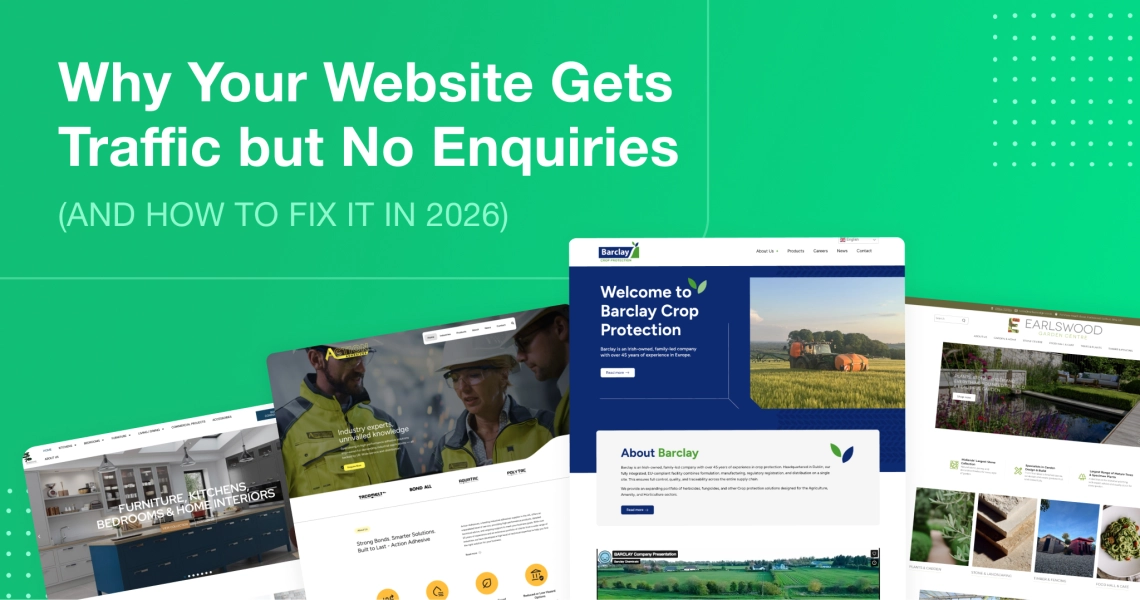
For many businesses, websites generate traffic but fail to convert that traffic into enquiries or sales. The assumption is usually that “more visitors” will naturally lead to growth. In 2026, that assumption no longer holds true.
The real issue is rarely traffic. It’s what happens after the click.
Most websites lose potential customers within seconds because the experience doesn’t guide users clearly enough toward action.
First Impressions Don’t Just Affect Trust — They Decide Whether Users Stay
When a visitor lands on your website, they immediately start asking three questions:
- Am I in the right place?
- Can this business solve my problem?
- What should I do next?
If those answers aren’t obvious within seconds, users leave even if your service is exactly what they need.
Common issues that quietly reduce conversions include:
- Unclear messaging above the fold
- Overly complex navigation
- Weak or missing calls-to-action
- Pages that don’t immediately explain value
Even if your website ranks well and attracts traffic, unclear structure will still cause users to drop off before they engage.
Traffic Without Structure Is Wasted Opportunity
Getting visitors to your site is only half the job. The real challenge is guiding them through a clear journey.
Without that structure, users behave unpredictably:
- They bounce between pages without context
- They fail to understand your core services
- They leave before reaching enquiry points
This is why two websites with the same traffic can produce completely different results. One is structured for clarity and conversion. The other is simply a collection of pages.
Small Frictions Create Big Conversion Losses
Conversion issues are rarely caused by one major problem. Instead, they come from small friction points that add up:
- Forms that feel too long or complicated
- Pages that load slowly or feel inconsistent
- Unclear service explanations
- Missing reassurance signals (case studies, proof, testimonials)
Each friction point reduces confidence. And when confidence drops, so do enquiries.
Why More Traffic Doesn’t Fix a Broken Funnel
Many businesses try to solve low enquiry rates by increasing traffic through SEO or ads. But if the underlying journey is unclear, more traffic simply leads to more drop-offs.
This is why conversion rate often matters more than traffic volume.
A well-structured website with lower traffic can outperform a high-traffic site that lacks clarity and direction.
Turning Existing Traffic Into Enquiries
Improving conversions is not about redesigning everything it’s about removing uncertainty.
Key improvements usually include:
- Clear, benefit-led messaging on key landing pages
- Strong, visible calls-to-action at every stage
- Logical page flow from homepage → service → enquiry
- Supporting content that builds trust (case studies, proof, results)
When users understand what you do and what to do next, they are far more likely to convert.
Final Thoughts
Traffic alone doesn’t grow a business. Structure does.
If your website is attracting visitors but not generating enquiries, the problem usually isn’t visibility it’s clarity.
At 2Cubed Web Design, we design websites around conversion logic from the ground up, ensuring that every visit has a clear path to action, not confusion or drop-off.