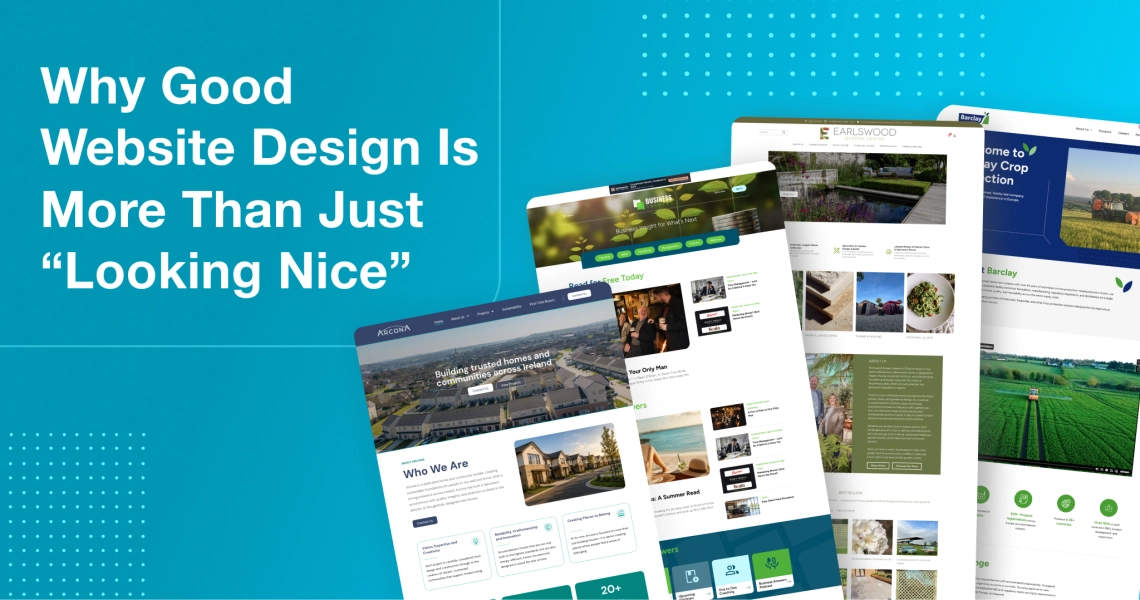
When people talk about website design, the conversation often stops at how a site looks.
Colours, typography, imagery, layout all of the visual elements tend to take centre stage.
But good website design is not just about appearance. It’s about communication, clarity, and how a business is perceived in seconds.
And those first impressions are rarely rational.
Users Judge a Website Before They Read a Word
Visitors don’t arrive on a website ready to study it.
They scan it instantly, forming an opinion before they’ve read any content.
In those first few seconds, design is doing all the work:
- Is this modern and credible?
- Does this feel trustworthy?
- Does this look relevant to what I need?
These reactions happen instinctively, not logically.
And once that impression is formed, it’s hard to change.
Design Shapes How a Business Is Perceived
Two websites can say the same thing, offer the same service, and even have similar content but feel completely different.
That difference is design.
It influences how professional a business appears, how established it feels, and how confident users are in taking the next step.
Strong design doesn’t exaggerate a business. It accurately represents its quality.
Weak design can do the opposite.
Clarity Is the Real Goal of Design
A well-designed website isn’t trying to impress people.
It’s trying to make things obvious.
Users shouldn’t have to think about:
- where to look
- what to click
- what matters most
- what the business actually does
Good design removes uncertainty.
If users are pausing to figure things out, the design is adding friction.
Design Influences Trust Before Anything Else
Trust is rarely built through information alone.
It starts visually.
Consistency, spacing, hierarchy, and attention to detail all contribute to whether a website feels credible.
Even if a business is strong, poor design can introduce doubt before a conversation even begins.
That doubt is often enough for users to leave.
Good Design Feels Invisible
The best-designed websites don’t draw attention to themselves.
They feel natural to use.
Users move through them without thinking about layout or style because everything behaves as expected.
That sense of ease is intentional. It comes from careful decisions about spacing, contrast, alignment, and visual balance.
When design is done well, it doesn’t interrupt the experience it supports it.
Final Thought
Your website should reflect the quality of your business while making it easy for visitors to understand, trust and engage with your brand. At 2Cubed, our web design services combine thoughtful design, clear user journeys and strategic thinking to create websites that look professional and perform effectively.