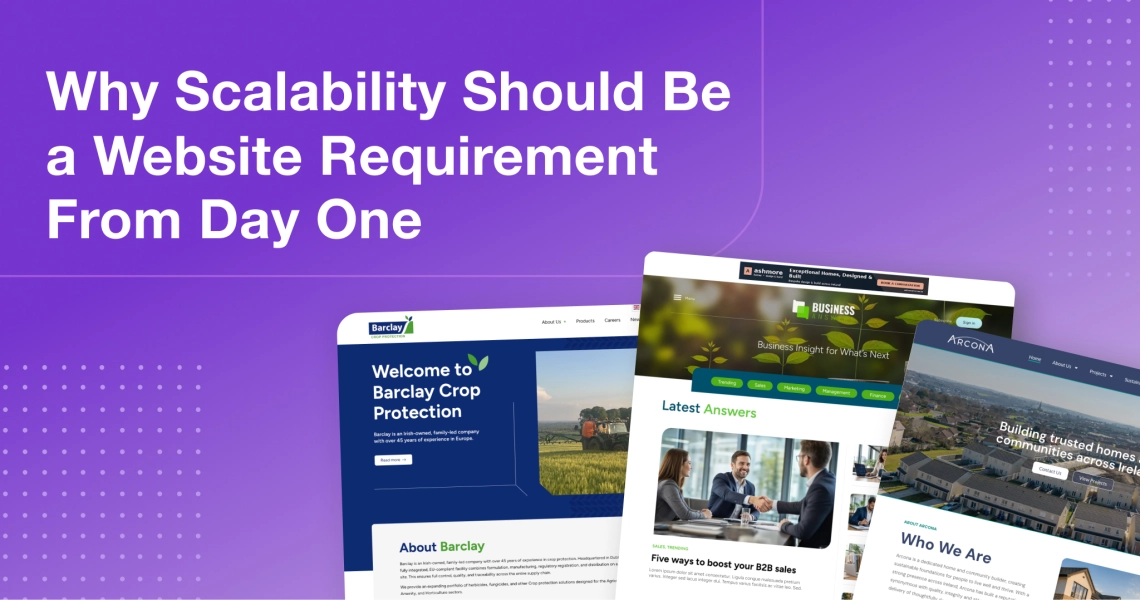
When a website is being built, most businesses focus on what they need right now, not what they’ll need in 12, 18, or 36 months.
That’s understandable. A website feels like a “current problem” to solve: get it live, make it look good, and start generating leads.
But the issue is this:
What works at launch is rarely what still works when the business starts to grow.
Scalability is often treated as a technical consideration. In reality, it’s a business one.
What “scalable website” actually means
Scalability isn’t just about handling more traffic.
It’s about whether your website can adapt as your business changes.
A scalable website should be able to support:
- New services or products without restructuring everything
- Additional content without breaking navigation or clarity
- Integrations with CRM, booking, or internal systems
- Increased demand without performance or maintenance issues
- Design and content updates without requiring rebuilds
If adding something new to your website feels difficult, expensive, or risky, it’s usually a sign the foundation wasn’t designed for growth.
Where most websites start to struggle
The problems don’t usually show up immediately.
They appear gradually as the business evolves.
Common breaking points include:
- Plugin dependency
What starts as a simple solution stack becomes fragile over time. Too many plugins lead to conflicts, slower performance, and maintenance issues. - Rigid page structures
Pages that were designed for a specific moment in time become difficult to expand or adapt without redesigning entire sections. - Content limitations
Businesses grow, but their website structure doesn’t. Adding new services or case studies becomes awkward or inconsistent. - Integration gaps
As operations evolve, businesses adopt CRMs, automation tools, or booking systems that the website wasn’t built to support.
At that point, the website stops being an asset and starts becoming a constraint.
Why rebuilding is always more expensive than building correctly
When scalability hasn’t been considered, businesses eventually reach a tipping point.
They don’t just update the website, they replace it.
And that second build is almost always more expensive than the first, because it’s solving problems that didn’t need to exist in the first place.
The real cost isn’t just financial either:
- Lost time reworking content
- Disruption to marketing activity
- SEO reset or migration issues
- Internal friction around systems and workflows
A scalable foundation avoids this entirely.
Scalability is not a “future feature” — it’s a structure decision
The mistake many businesses make is assuming scalability can be added later.
In reality, it needs to be built into:
- Information architecture
- Content modelling
- CMS setup
- Development approach
- Integration planning
Once the structure is in place, everything else becomes easier to evolve.
Without it, every improvement becomes a workaround.
Building for where your business is going, not where it is
A website should reflect more than what your business looks like today.
It should be able to support where it’s heading next.
That means thinking beyond design and considering how the site will operate as the business grows:
- Will new services fit naturally into the structure?
- Can content expand without becoming messy?
- Will systems connect cleanly as operations mature?
- Can the site evolve without constant rebuilds?
If the answer to these is unclear, scalability hasn’t been fully considered.
Final thought
A website should be built to support where your business is going, not just where it is today. At 2Cubed, our web design services consider scalability from the outset, from site structure and content management to performance and future integrations. Explore our Web Design services to learn how we create flexible, scalable websites designed to evolve alongside your business.