One of the most common issues we see with growing eCommerce businesses isn’t a lack of products or capabilities it’s a lack of accurate representation online.
Many eCommerce businesses we work with are already operating at scale. They’re selling multiple product lines, handling inventory efficiently, and delivering strong customer experiences. But their website tells a very different story.
Instead of reflecting their professionalism, reliability, and capacity to deliver, their online store can look small, outdated, or confusing. And that disconnect quietly limits sales, undervalues the brand, and attracts the wrong buyers.
Your Website Is a Filter, Whether You Mean It to Be or Not
Your website isn’t just a sales tool, it’s a screening mechanism.
Visitors are silently asking:
- Can I trust this site with my purchase?
- Are they capable of fulfilling orders efficiently?
- Will this brand meet my expectations for quality?
If the answers aren’t immediately clear, customers often leave without buying. Meanwhile, the visitors who do purchase may not be your ideal customers they may expect discounts, return products more often, or be less loyal.
The Hidden Cost of Looking Smaller Than You Are
A poorly positioned eCommerce site doesn’t usually fail dramatically. It fails quietly.
Over time, this can cause:
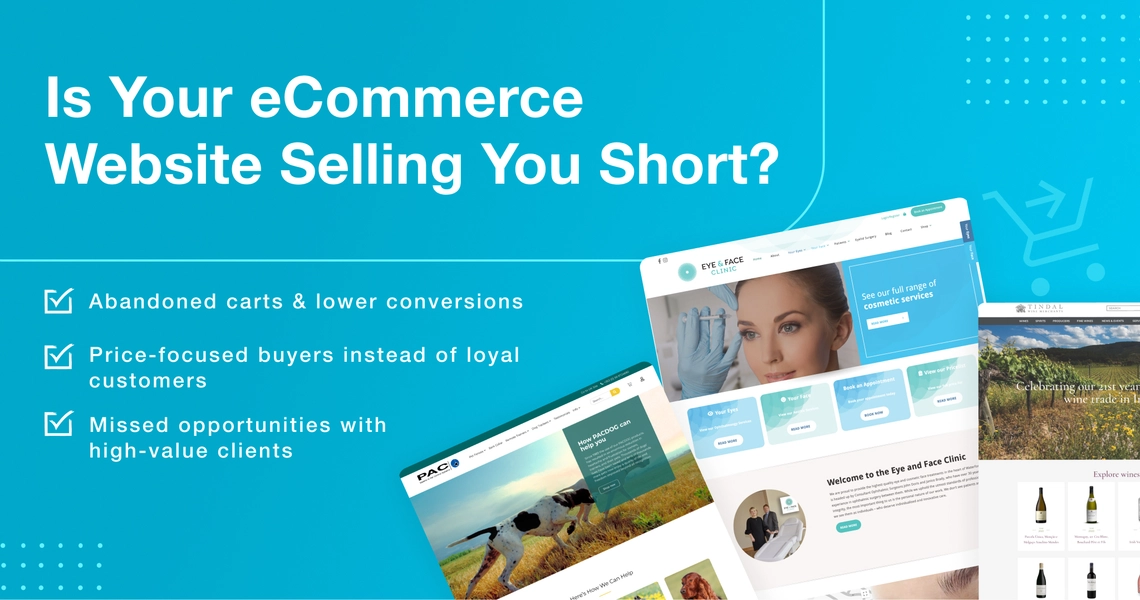
- Cart abandonment or fewer completed sales
- Price-focused customers instead of loyal buyers
- Increased returns or customer service workload
- Missed opportunities with high-value clients
It’s subtle, but collectively, it slows growth and reduces brand perception.
A Website Signals Who You’re For
Your eCommerce site isn’t just showing products; it signals the type of customer you want to attract. When the design, messaging, or user experience undersells your professionalism, it encourages smaller, less loyal buyers, while discouraging high-value shoppers.
The goal isn’t to exaggerate it’s to reflect your brand accurately.
Why This Happens to Good eCommerce Businesses
This problem is especially common in stores that have grown over time:
- The site was originally built to “just get products online”
- Design and UX were optimized for a smaller product range
- Strategic messaging hasn’t kept up with new offerings
Internally, operations have evolved but externally, the site hasn’t kept pace.
What a Correctly Positioned eCommerce Website Does
A well-positioned site reassures visitors. It makes them feel:
- “This brand knows what it’s doing.”
- “I trust their products and service.”
- “This is the kind of store I want to buy from.”
Clarity replaces persuasion. Fit replaces volume.
The Shift That Changes Buyer Quality
When positioning is corrected, we see:
- Fewer abandoned carts
- Higher-value customers
- Shorter decision-making time
- Stronger brand loyalty
Not because the products changed but because the website finally communicated what the business was really capable of.
Final Thought
If your eCommerce business has grown beyond what your website seems to sell, that’s not a marketing problem it’s a positioning gap. Closing it can transform casual visitors into loyal, high-value customers.
FAQs
How can I tell if my eCommerce site is underselling the business?
If conversions are low despite strong traffic, or if your average order value is lower than expected, the site may not be communicating professionalism or reliability.
Can an under-positioned site really limit growth?
Yes. Customers self-select out if trust signals, speed, or quality aren’t evident.
Is it a design problem or messaging problem?
Both. UX, visuals, and content must all communicate credibility. Fixing one without the other usually doesn’t solve the issue.
Do we need to oversell or discount to attract better buyers?
No. The goal is accuracy, clarity, and confidence not exaggeration.
When should an eCommerce business reassess its website?
If product range, order volume, or operational complexity has grown but the site hasn’t been strategically updated, it’s time to reassess.