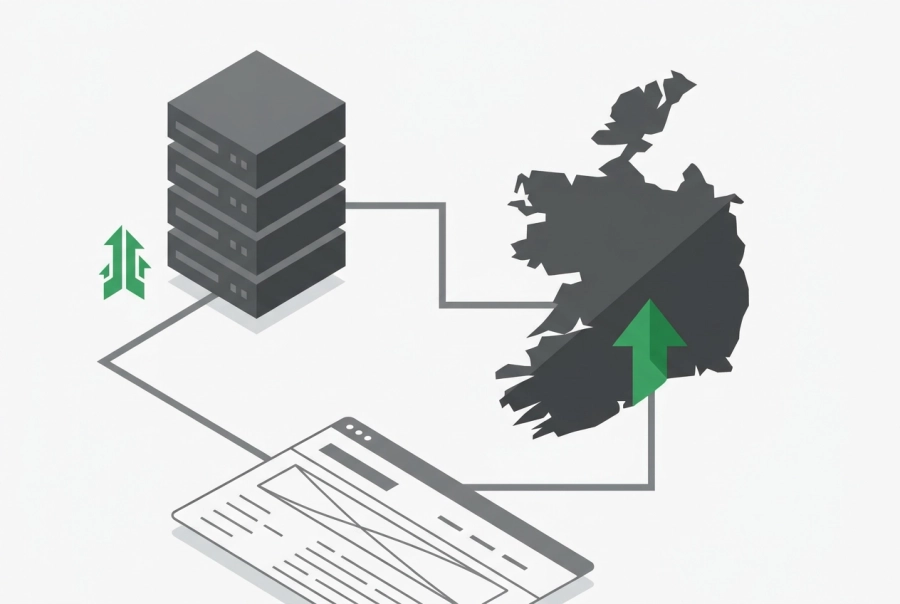
Most Irish online stores are built to look good. Very few are built to be found. That gap is where revenue gets lost, and it starts on day one.
Getting ecommerce website SEO right is not about clever tricks or chasing algorithm updates. It is about making foundational technical decisions correctly from the start, decisions around URL structure, crawlability, page speed, and structured data that quietly compound into organic traffic and sales over months and years. Retrofit them later and you are looking at significant cost and disruption. Build them in early and they work for you around the clock without ongoing ad spend.
This tutorial is written for Irish eCommerce business owners and beginners who want to understand what technical SEO actually means in practical terms. You will learn why organic search consistently delivers the highest return on investment of any acquisition channel, what a technically sound site looks like under the bonnet, and how to prioritise fixes if you are starting from an imperfect foundation. By the end, you will have a clear framework for building, or rebuilding, your store the right way.
Why Organic Search Is the Highest-ROI Channel for Irish eCommerce
Paid advertising stops delivering the moment you stop paying. Organic search works the opposite way: rankings, once earned, continue generating traffic and revenue without a recurring cost attached to each click. For Irish SMEs working with finite marketing budgets, that structural difference matters enormously.
Irish consumers are heavily Google-dependent at every stage of the buying process. From initial product discovery through to comparing options before checkout, search drives purchasing decisions in a way no other channel matches. If your store is not visible in those searches, a competitor’s store is.
The economics improve as rankings strengthen. Cost-per-acquisition from organic traffic falls over time as a site climbs the rankings and captures more clicks from the same searches. Paid channels move in the opposite direction: increased competition pushes up auction prices, meaning you pay more per customer as the market matures. For an Irish eCommerce business scaling on a lean budget, organic search is the channel that gets cheaper as it grows, while paid search gets more expensive.
Here is where the competitive opportunity becomes concrete. Research from technical audits consistently shows that 65% of business websites carry at least one critical crawlability issue, typically duplicate content, slow load times, or missing structured data. A technically clean store outranks the majority of the market before a single piece of content or a single backlink is even considered. The baseline is lower than most store owners realise.
The time-to-return is also faster than most people expect. Unlike content marketing, which builds slowly over months, technical SEO fixes deliver ranking improvements within weeks as Google re-crawls and re-indexes corrected pages. That makes it one of the most immediate-return investments open to an Irish online store owner.
For context on how technical decisions intersect with the broader Irish search landscape, the Local SEO Strategies for Irish Businesses post-Google updates on the 2Cubed blog covers how algorithm changes affect Irish businesses specifically.
The rest of this guide covers precisely which technical foundations drive those gains and in what order to build them.
What Technical SEO Actually Means (Without the Jargon)
So organic search is the channel worth investing in. But investing in it without understanding what’s underneath the surface is where most Irish online stores go wrong.
Content SEO is what you say on your site. Technical SEO is whether search engines can find, read, and understand it. Both must work together. You can write the best product descriptions in Ireland, but if Google’s crawlers cannot access those pages, they will never rank.
Technical SEO covers the infrastructure layer of your site: how pages are structured, how crawlers navigate between them, how quickly they load, and how information is communicated to search engines through code-level markup. None of this is visible to shoppers. All of it shapes whether your store appears in search results.
For eCommerce sites, this infrastructure layer carries more weight than it does for almost any other site type. A standard business website might have twenty pages. An online store can have thousands of product pages, each needing to be discoverable, indexable, and free of duplicate content issues. That scale is what makes technical SEO non-negotiable for Irish stores, not optional.
The most useful way to think about it: technical SEO is the plumbing of your online store. When it works correctly, nobody notices. When it breaks, the consequences are severe and the cost to fix it retrospectively is significant. Changing URL structures after launch, untangling years of duplicate content, or rebuilding site architecture mid-trade are each expensive, disruptive projects that the right foundations at the start would have avoided entirely. A technical SEO audit can surface exactly where those foundations are weak before they compound into bigger problems.
The core technical checklist for any Irish eCommerce site covers nine areas:
- URL structure and site architecture
- robots.txt configuration
- XML sitemaps
- Canonical tags
- HTTPS security
- Mobile responsiveness
- Page speed
- Structured data markup
Each of these is covered in detail in the sections that follow.
URL Structure and Site Architecture: The Decisions You Cannot Undo Cheaply
Of all the technical decisions covered in this guide, URL structure and site architecture have the most permanent consequences. Get them wrong at launch and you are not fixing a setting; you are dismantling and rebuilding load-bearing walls.
Start with descriptive, human-readable URLs. A URL like /shop/womens-boots/ tells both users and Google’s crawlers exactly what the page contains before it is even visited. A URL like /category?id=4872 communicates nothing. Google’s own eCommerce URL guidance recommends using words rather than numbers or parameters in URLs precisely because descriptive paths signal relevance directly. This matters for click-through rates in search results as much as it matters for crawlers.
Keep your architecture shallow. Every product page should be reachable within three clicks from the homepage. Deep, buried pages receive less crawl attention and accumulate less internal link equity, which means they rank below their potential. A flat structure, with clear category and subcategory layers, keeps crawl budget focused on pages that generate revenue.
Category pages deserve keyword strategy, not just labels. A category page titled “Boots” is a navigation element. A category page optimised for “leather boots Ireland” is a mid-funnel landing page targeting consumers who are close to purchasing. This distinction has real commercial value for Irish stores, and it costs nothing extra to implement correctly at the build stage.
Changing URLs after launch is expensive. Restructuring URLs post-launch triggers redirect chains, orphaned pages, and temporary ranking losses that typically take months to recover from. Architecture is a founding decision.
Handle faceted navigation before it handles you. Filters for size, colour, and price generate large volumes of near-duplicate URLs automatically. Without canonical tags or URL parameter controls in place from day one, these pages can dilute crawl budget and fragment ranking signals across hundreds of functionally identical pages. This is one of the most common technical issues found in eCommerce SEO audits.
For stores targeting both Irish and UK consumers, a single coherent domain structure with clear geographic signals outperforms splitting authority across subdomains or separate subdirectory trees unnecessarily. Keep the site’s authority unified unless there is a clearly defined reason to separate it.
If you are building or rebuilding a store, the eCommerce websites built for search and conversion that perform best in organic search share one trait: these architectural decisions were made before a single product was uploaded, not after.
Crawlability Essentials: Robots.txt, Sitemaps, Canonicals, and HTTPS
Once your URL structure and architecture are in place, the next layer determines whether search engines can actually navigate what you have built.
Robots.txt is a plain-text file sitting at the root of your domain that instructs crawlers which pages to access and which to skip. A missing or misconfigured robots.txt is not a minor housekeeping issue; it is one of the most damaging errors an eCommerce site can make. A single incorrect directive can accidentally block every product page on the store from being indexed. Google Search Console provides a robots.txt report where you can confirm the file is being fetched and parsed correctly, before an indexing problem costs you rankings.
XML sitemaps give crawlers a complete list of every URL worth indexing: product pages, category pages, blog posts. Without one, crawlers rely entirely on following links through your site, and pages buried deeper in the architecture may never be discovered. Submit your sitemap directly through Google Search Console so Google can schedule it into its crawl cycles rather than stumbling across it later.
Canonical tags address the duplicate content problem that is built into how eCommerce works. When the same product appears under multiple category paths, or when size and colour variants generate near-identical URLs, Google sees multiple pages competing with each other. A canonical tag on each variant points to the single preferred URL, consolidating ranking signals rather than splitting them.
HTTPS is a confirmed Google ranking factor, and for Irish eCommerce stores it carries a second penalty beyond rankings: consumers entering payment details on an unencrypted site will see browser security warnings. That combination of ranking loss and conversion loss makes an invalid SSL certificate one of the most expensive problems a store can have.
Finally, internal linking is an underappreciated crawl tool. Linking from your homepage to priority collections, from blog content to relevant category pages, and between related products steers crawl budget toward the pages that generate revenue. For a practical overview of what a well-structured site should include beyond SEO mechanics, see what every Irish business website needs in 2026.
Structured Data and Schema Markup: How Irish Stores Win Rich Snippets
Once crawlers can reliably access your pages, the next question is what they understand when they get there. Structured data closes that gap.
Structured data is machine-readable code added directly to your product pages. Rather than leaving Google to interpret your content, it explicitly tells search engines the product name, price, availability, and review rating. That communication unlocks rich snippets: the enhanced search results that display star ratings, price ranges, and stock status before a shopper ever clicks.
Product schema is the highest-value implementation for any Irish online store. A search result showing “€89 · In stock · 4.7 stars” commands attention in a way that a plain blue link cannot. The impact on SEO is measurable: richer results consistently earn higher click-through rates, meaning the same ranking position delivers more traffic when schema is correctly implemented.
Review markup deserves equal priority. Aggregate ratings pulled into search results function as a public trust signal, and for Irish consumers comparing products across unfamiliar stores, that signal is often the deciding factor. A store showing 4.6 stars in results appears credible before the page loads. A competitor without schema appears identical to a blank unknown.
FAQPage schema adds a different kind of leverage. Applied to product and category pages, it can expand your search result to include answered questions directly beneath the main listing. Common buyer questions, delivery to Ireland, return windows, sizing guidance, can all appear in results for a page that is already ranking, effectively increasing that page’s real estate without earning a higher position.
In 2026, this is not a nice-to-have layer of eCommerce website SEO. Competitors who have implemented schema correctly appear more prominent and more trustworthy. Without it, a store is functionally less visible even when ranking at the same position.
Implementation steps:
- Add Product, Review, and FAQPage schema using JSON-LD format, Google’s recommended method
- Validate each implementation using Google’s Rich Results Test
- Monitor Google Search Console’s Enhancements report for flagged errors
- Resolve errors promptly; unresolved markup errors suspend rich snippet eligibility until corrected
Schema is one of the few technical investments where the visible return in search results is immediate and directly attributable.
Core Web Vitals and Page Speed: What Google Is Actually Measuring
Structured data makes your pages more visible in search results; page speed determines whether users stay once they arrive. Both are measurable ranking signals, and both are within your control.
Largest Contentful Paint: Your Store’s First Impression
Largest Contentful Paint (LCP) measures how long the main content of a page takes to render in the browser. On a product page, that is typically the hero image or primary product photo. Google’s “Good” threshold is under 2.5 seconds. Stores that miss it do not just rank lower; they lose the visitor at the same moment they lose the position, making slow LCP a double penalty.
Interaction to Next Paint (INP) replaced First Input Delay in March 2024 and measures how quickly a page responds after a user interacts with it. On an eCommerce store, that means tapping “Add to Cart” or opening a product variant. A sluggish INP score signals a poor browsing experience, and Google uses it directly as a ranking factor for both mobile and desktop.
Mobile-First Indexing and What It Means for Irish Stores
Google primarily uses the mobile version of your site when crawling and ranking. If your mobile experience is slow, cluttered, or missing content that appears on desktop, your store is being ranked on its weakest version. For Irish eCommerce sites where mobile accounts for the majority of browsing sessions, this is not an edge case; it is the main case.
What Is Slowing Your Store Down
The most common speed killers on eCommerce sites are:
- Uncompressed product images: large files are the single biggest LCP culprit
- Third-party scripts: live chat widgets, analytics tags, and pixel trackers each add load time
- Render-blocking CSS or JavaScript: code that delays the browser from displaying content
- Underpowered hosting infrastructure: shared hosting that cannot handle concurrent product page requests
Every one of these is diagnosable and fixable. Google Search Console’s Core Web Vitals report and PageSpeed Insights both provide real-world field data and specific recommendations, giving you a clear baseline before and after any website optimisation work is carried out.
The Compounding Logic of Speed
Faster sites earn better rankings. Better rankings bring more traffic. More traffic generates more revenue to reinvest in further improvements. The reverse is equally true: a slow site suppresses rankings, reduces traffic, and narrows the budget available to fix the underlying problem. Speed is not a one-time fix; it is a compounding asset or a compounding liability, depending on which side of 2.5 seconds you sit.
Platform-Specific Considerations: Shopify, WooCommerce, and Custom Builds for Irish Stores
How well your platform handles the technical foundations above is not uniform. The choice between Shopify, WooCommerce, and a custom build carries real SEO consequences that compound across the life of your store.
Shopify is the easiest platform to launch on, and its SEO defaults are genuinely solid: automatic XML sitemap generation, canonical tags applied out of the box, and HTTPS enabled by default. For a beginner, this removes several early mistakes. The limitations matter, however. Shopify enforces fixed URL structures, so products always sit under /products/ and collections under /collections/. You cannot remove these prefixes without third-party workarounds, which creates structural constraints that experienced SEOs would design around if given the choice. Crawl directive control is also limited compared to more open platforms.
WooCommerce, built on WordPress, offers the most technical SEO flexibility of any widely-used eCommerce platform. URL structures are fully customisable, robots.txt is directly editable, and a mature ecosystem of schema plugins gives you precise control over structured data implementation. The trade-off is that flexibility requires active management. A WooCommerce store with no technical oversight will not configure itself correctly; the control is only an advantage when someone uses it deliberately.
Custom-built eCommerce websites designed for the Irish market represent complete architectural freedom. URL structures, site hierarchy, and structured data can all be designed around your specific product catalogue and target audience from the first line of code, with no platform constraints to work around.
For Irish businesses also selling to UK consumers post-Brexit, this platform decision intersects with hreflang implementation. Hreflang tags signal to Google which version of your site targets which geographic audience. Incorrect implementation causes Irish and UK pages to compete against each other in search results, cannibalising both.
One further consideration: platform migrations are among the most technically hazardous events in an eCommerce site’s lifespan. Moving from Shopify to WooCommerce, for example, requires a complete redirect map, crawl comparisons before and after, and close Search Console monitoring. Mismanaged migrations cause ranking losses that take months to recover.
Finally, evaluate platform cost over three to five years, not just at build time. A platform with weak SEO defaults creates ongoing technical debt requiring specialist intervention to manage. Choosing the right eCommerce web design agency in Ireland to guide this decision is itself a technical choice worth making carefully.
The 2026 Frontier: AI Crawler Optimisation for eCommerce Sites
Beyond platform choice, there is a newer technical layer that most Irish eCommerce stores have not addressed at all: optimising for AI-powered search.
ChatGPT, Perplexity, and Google’s AI Overviews use dedicated crawlers that operate differently from traditional Googlebot. Where Googlebot indexes pages for ranked results, AI crawlers are building context: they need to understand which pages on your site are authoritative, what your products actually are, and which content should surface when a user asks an AI assistant for a recommendation. You can guide them directly using a file called llms.txt, placed in the root of your domain.
The llms.txt file is a plain markdown document that functions as a curated guide for large language model crawlers. Unlike robots.txt, which issues allow or deny directives, llms.txt signals priority: here are our key category pages, here are our most important product pages, here is what this store sells. AI retrieval pipelines use these declared signals when deciding what to cite. A Princeton study published in May 2026 found that sites with well-structured llms.txt files earned 23 per cent more AI citations across major AI search platforms compared to matched sites without one. The W3C opened a formal standardisation process for the specification in June 2026, confirming this is no longer an experimental concept.
For Irish store owners, the strategic point is straightforward: consumers are already asking AI assistants what to buy. Stores structured for AI crawler comprehension gain early visibility in that channel.
The good news is that the groundwork is already largely done for stores that followed the structured data guidance covered earlier in this guide. Clear semantic HTML and schema markup are prerequisites for AI crawler comprehension; understanding how AI SEO differs from traditional search is the logical next step once those foundations are in place.
Current adoption of llms.txt sits at roughly 14 per cent of the global top 100,000 sites, concentrated in B2B and technology domains. Irish eCommerce adoption is negligible. That is the first-mover opportunity: implement now, before competitors recognise the channel exists.
What to Fix First: A Prioritisation Framework for Irish SME Online Stores
Knowing what needs to be done is only half the problem. Knowing what to do first is where most Irish SME eCommerce stores stall.
Tier 1: Fix immediately. HTTPS, XML sitemap submission to Google Search Console, a robots.txt audit confirming no product pages are accidentally blocked, and canonical tag coverage across product and category pages. These are non-negotiable crawlability foundations. Any deficiency here renders every other SEO effort pointless, because Google cannot reliably find or trust what it cannot reach.
Tier 2: Fix within the first quarter. Review your URL structure and flatten site architecture if products are buried more than three clicks from the homepage. Optimise Core Web Vitals, prioritising LCP and INP scores. Run a mobile experience audit. These issues directly influence rankings, and once fixed, measurable improvement typically follows within four to eight weeks as Google re-crawls the updated pages.
Tier 3: Build out over six months. Implement product schema and review markup, add FAQPage schema to key category and product pages, develop a deliberate internal linking structure, and begin publishing blog content that targets informational queries feeding into purchase decisions. This tier amplifies pages that are already ranking; it delivers little value if Tiers 1 and 2 are incomplete.
Tier 4: 2026 and beyond. AI crawler optimisation via llms.txt, structured content for AI search visibility, and ongoing Core Web Vitals monitoring as Google’s thresholds continue to evolve. Early movers gain a compounding advantage as AI-assisted search grows in Irish consumer behaviour.
The sequence matters more than the speed. For Irish SMEs operating with limited technical resource, attempting all four tiers simultaneously is how eCommerce SEO projects lose momentum and produce no measurable result. Fix what blocks crawlers first. Fix what slows pages down second. Then add structured data to amplify what is already performing.
A professional technical SEO audit, scoped specifically for eCommerce website SEO, surfaces issues in exactly this priority order with estimated business impact attached to each. For business owners who are not technical specialists, that audit removes the guesswork entirely and turns a complex domain into a clear, sequenced action list.
Building It Right Costs Less Than Fixing It Later
The prioritisation framework above tells you what to fix and in what order. The harder truth is that the most expensive version of this problem is the one where none of it was considered at launch.
Technical SEO decisions compound in both directions. A store built with clean architecture, correct canonicalisation, and structured data in place accumulates ranking authority from day one. A store that launches without these foundations spends its early months either invisible in search or actively suppressed by issues it does not know it has. Retrofitting URL structures, implementing schema across hundreds of product pages, or correcting crawl errors on a live site all carry real costs in developer time, temporary ranking disruption, and delayed revenue.
For Irish eCommerce businesses, the arithmetic is straightforward. Organic search reduces cost-per-customer over time as rankings improve and traffic compounds without corresponding increases in spend. Paid acquisition does the opposite. Every month a technically sound store is live, it widens the gap on competitors whose foundations are still broken.
The practical next step for most Irish store owners is a technical audit. Not a general review, but a structured assessment that identifies exactly what is blocking rankings, what is degrading page speed, and what structured data opportunities are currently untapped. That audit converts an abstract problem into a prioritised action list with measurable outcomes.
2Cubed works with Irish eCommerce businesses across Wexford, Dublin, and nationally to design, build, and technically optimise online stores. From initial architecture decisions through to ongoing SEO services in Ireland, the focus is consistent: make organic search a sustainable, compounding revenue channel from the earliest possible stage, not a retrofit project that costs more than it should have.
Conclusion
Technical SEO is not a one-time task or a luxury reserved for large retailers. It is the structural layer that determines whether your Irish online store earns sustainable organic revenue or remains permanently dependent on paid spend.
The core lessons from this guide are clear. Get your URL structure and site architecture right before launch. Ensure Google can crawl, index, and understand every page you want ranked. Implement structured data to compete for rich snippets. And treat Core Web Vitals as a commercial priority, not a developer checkbox.
Every month your foundations are solid, your organic advantage compounds. Every month they are broken, a competitor pulls further ahead.
If you are ready to stop guessing and start building on ground that holds, a structured technical audit is the right first step. Learn more about the SEO services we have to offers.
Book a consultation with 2Cubed and turn your organic search potential into measurable, repeatable revenue.