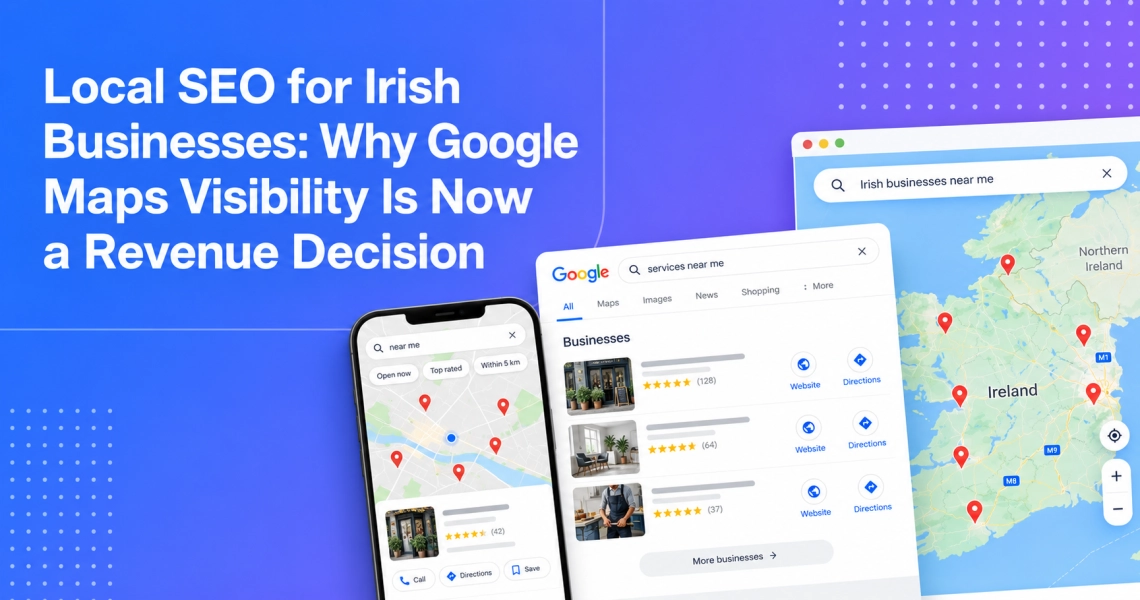
Nearly half of all Google searches have local intent. That single statistic should change how every Irish business owner thinks about their digital presence. If your business is not actively competing for visibility in the Google Maps pack, you are already invisible to a significant share of potential customers searching for exactly what you offer, right now, in your area.
Local SEO in Ireland is no longer a technical exercise reserved for marketing specialists. It is a revenue decision, and the businesses treating it as one are pulling ahead while others remain stuck with incomplete profiles and unmanaged reviews. The data is unambiguous: 76% of people who perform a “near me” search visit a business within 24 hours, and 97% of consumers check online before walking through a door.
This post breaks down why the Google Maps pack has become the most consequential battleground in Irish local search. You will learn what the conversion data actually shows, which four signals determine your ranking, how reviews now function as a direct ranking mechanism, and what the minimum standard for local visibility looks like in 2026. If you are new to local SEO, this is where to start.
The Map Pack Is Not a Bonus, It Is the Battleground
46% of all Google searches carry local intent. In practical terms, nearly half of every search made in Ireland today represents a potential customer looking for something nearby. If your business is not appearing in the Google Maps pack, that intent passes you entirely.
The stakes of that absence are not marginal. Businesses ranking in the Local Pack capture 42% of all clicks on desktop and 54% on mobile. In competitive categories, the single best-optimised competitor captures 71% of all pack clicks, leaving the remainder split between the other two visible businesses. There is no meaningful traffic left for whoever ranks fourth.
Google Maps has crossed 2 billion monthly active users globally, with over 8 billion local searches processed every day. It is no longer a supporting feature alongside Google Search; it has become the primary discovery layer for commercial local intent. Businesses that treat it as secondary are misreading where their customers are actually looking.
The direction of travel reinforces this. Google Business Profile actions, covering calls, direction requests, website clicks, and bookings, surged 41% year-over-year between 2025 and 2026. Google is actively investing in Maps as the default interface for local commercial decisions, not stepping back from it.
For Irish SMEs competing in towns, cities, or regional markets, the map pack is the most contested piece of digital real estate available. Understanding what drives visibility there is where any serious local SEO strategy begins. Our analysis of local SEO strategies for Irish businesses post-Google updates covers how the ranking environment has shifted and what it demands from businesses operating in this market.
What the Conversion Data Actually Tells Us
Visibility in the map pack means nothing if the traffic it delivers does not convert. The data makes clear that it does, at a rate that should reframe how every Irish SME thinks about this channel.
76% of people who search with local intent visit a business within 24 hours. That is not someone casually browsing; that is a buyer making a same-day decision. 28% of those visits result in a purchase, making local search more conversion-ready than virtually any paid or organic channel an SME could invest in.
Mobile amplifies this further. 88% of mobile users who conduct a local search visit a store within a week, and given that 54% of Local Pack clicks already come from mobile devices, the smartphone is now the primary path to your front door. A customer searching “plumber Wexford” on their phone at half ten on a Tuesday morning is not doing research; they are picking up the phone.
The trust dimension matters just as much. 97% of consumers check online before visiting a business. An incomplete or unmanaged Google Business Profile does not simply lose you clicks; it signals neglect before a potential customer has even considered calling. For businesses working to generate more enquiries, that first impression is often the only one.
These figures are not an argument that local SEO might help. They are evidence that its absence is measurably costing Irish businesses foot traffic, calls, and sales every single day. Understanding how AI search is reshaping local visibility in 2025 and beyond makes the case for acting now even stronger.
Why Most Irish SMEs Are Losing Ground Right Now
That conversion data reveals one half of the problem. The other half is behavioural: most Irish SMEs have done the bare minimum once and stopped.
The dominant pattern is a Google Business Profile claimed two or three years ago, left untouched since. That is not a neutral position. Against competitors actively posting updates, uploading photos, and responding to reviews, a dormant profile is a liability. With 80% of consumers searching for local businesses at least once a week and 32% doing so daily, your profile is being evaluated constantly, whether you are managing it or not.
The competitive gap is specific and measurable. Businesses with 50 or more photos, a rating of 4.5 stars or above, and consistent review responses capture a disproportionate share of Local Pack visibility. The difference between an optimised and an unoptimised profile is not a marginal ranking nudge; it determines whether you appear at all.
Across retail, hospitality, trades, and professional services, Irish SMEs are routinely underperforming on fundamentals that directly affect ranking eligibility: incorrect primary category, missing service areas, inaccurate opening hours, and low-quality or absent photos. Each of these is a signal Google uses to assess relevance and rank accordingly.
The important point for businesses researching local SEO in Ireland is this: the businesses ranking for competitive local queries are not necessarily the best in their field. They are simply the ones treating local SEO as an ongoing managed function rather than a background task completed once and forgotten.
The Four Signals That Determine Your Map Pack Ranking
Google’s local algorithm weighs four distinct signals, and underperforming on any one limits your overall ranking ceiling.
Google Business Profile completeness and activity is the foundation. Google’s own guidance confirms that businesses with complete, accurate information are more likely to appear in local results. Accurate NAP, correct primary and secondary categories, a detailed business description, current opening hours, and regular profile posts all signal that the profile is actively managed and trustworthy.
Review velocity and response rate function as a direct ranking input, not a reputation nicety. 87% of consumers read reviews before choosing a local business, and businesses that respond within one hour see 34% higher click-through rates. Recency matters as much as volume; a steady stream of recent reviews outperforms a large but stagnant total.
On-site local signals and structured data are where technical SEO connects to map pack eligibility. Location pages with LocalBusiness schema markup and consistent NAP across the website reinforce geographic relevance. Understanding what search engines actually reward on modern websites makes this clearer; structured data is among the most neglected areas for Irish SMEs yet carries significant weight.
Citation consistency across platforms, including Irish directories, social profiles, and industry listings, reinforces categorical and geographic relevance in Google’s local algorithm. Inconsistent NAP across sources creates conflicting signals that suppress rankings.
Mobile optimisation of the landing experience closes the loop. Because 54% of Local Pack clicks arrive from mobile devices, a slow or cluttered landing page erodes every ranking gain made elsewhere.
Reviews Are No Longer Just Social Proof, They Are a Ranking Mechanism
Of all the ranking signals discussed above, reviews are the one where Irish SMEs have the most immediate control, and where most are doing the least.
87% of consumers read reviews before deciding on a local business. That means a prospective customer has already formed an opinion based on your review profile before they visit your website, read your service descriptions, or consider your pricing.
Velocity matters more than volume. A business with 200 reviews accumulated over three years is outranked in freshness signals by a competitor with 30 reviews from the past six months. Google treats recency as an indicator of an active, credible business. An old review profile, however large, does not carry the same weight it once did.
Response time is equally measurable. Businesses that reply to reviews within one hour see 34% higher click-through rates from their Google Business Profile. Most Irish businesses are not doing this, which makes it a genuine competitive opening.
Building review velocity does not require a technical overhaul. Asking at the point of sale, sending a follow-up SMS or email after a job is complete, or placing a QR code at the till are all low-effort methods that produce consistent, genuine reviews and directly influence Local Pack rankings.
Negative reviews, handled promptly and professionally, perform better in customer perception than unacknowledged positive ones. Responding to every review signals active management. That signal converts map pack impressions into actual visits.
Google Maps Versus Other Local Discovery Channels
Reviews establish trust; the channel you are discovered on determines the quality of intent behind that trust.
The platform breakdown is instructive. Globally, 72% of consumers use Google Search for local discovery, 51% use Google Maps specifically, 49% use Facebook, and 33% use Instagram. For Irish SMEs, this means Google properties together form the dominant discovery stack, and no social platform comes close to matching that reach for location-based queries.
The more important distinction, however, is intent. Facebook and Instagram serve real purposes in awareness and remarketing, but a user scrolling a feed is browsing. A user searching “accountant Wexford” has already decided they need an accountant and is choosing between options. That is a fundamentally different moment, and Maps captures it directly.
Presence across all four platforms does outperform single-channel strategies, so the argument is not to abandon social. It is to recognise that Google Maps is the non-negotiable foundation because it intercepts purchase-ready intent at the precise moment of decision. Social channels support that journey; they rarely initiate the final step.
AI is now accelerating this hierarchy further. Google is integrating AI-generated summaries into local query results, drawing directly from Google Business Profile data. Businesses that are already well-optimised carry that signal advantage into AI-mediated results. Those who delay optimisation will enter an environment where the algorithmic ground has shifted and the established profiles hold compounding authority.
For any business owner researching SEO services in Ireland, the channel priority question has a clear answer: Maps is where the highest-converting local traffic originates, and it is where optimisation delivers the most direct commercial return.
What Active Local SEO Management Looks Like in Practice
Knowing which channels matter is only half the equation. The other half is execution.
Weeks one to two: Begin with a full Google Business Profile audit. Verify ownership, correct primary and secondary categories, update opening hours, and write a business description that naturally includes your core service terms. Upload a minimum of 20 high-quality photos and confirm that your name, address, and phone number match your website exactly. NAP inconsistency between your profile and site is a common, invisible drag on Local Pack eligibility.
Weeks two to four: Implement LocalBusiness schema markup on your website, build dedicated location or service-area pages, and display consistent NAP in the footer. This technical layer connects your on-site relevance signals directly to your GBP, reinforcing your eligibility in the pack.
Weeks two to eight: Launch a review generation process using post-service prompts, SMS follow-ups, or in-store QR codes. Establish a response protocol: every review, positive or negative, should receive a reply within 24 hours and ideally within one hour.
Ongoing monthly: Publish GBP posts to signal recency, audit citation consistency across major directories, monitor Local Pack rankings for primary service terms, and track calls, direction requests, and website clicks as direct revenue indicators.
For Irish SMEs, this is not a one-month project. Sustained Local Pack visibility requires continuous signal management, not a single setup. 2Cubed builds SEO strategy around exactly that model, with ongoing optimisation rather than one-time fixes, because that is what the algorithm rewards. Contact 2Cubed and let us manage SEO for your website.
The Cost of Inaction Is Not Abstract
Knowing what active local SEO management looks like is one thing; understanding what it costs to delay it is another.
At 8 billion local searches processed daily on Google Maps, absence from the Local Pack is not a passive state. Every day a competitor ranks where your business does not, they receive the calls, direction requests, and walk-ins that would otherwise be yours. Inaction is quietly expensive in a way that is easy to dismiss until the pattern shows in revenue.
For Irish SMEs in competitive categories, trades, professional services, hospitality, retail, the stakes are binary. The gap between ranking in the top three results and not appearing at all is not a marginal visibility difference. It is the difference between existing in a customer’s decision set and being entirely absent from it. Customers choosing between options they found on Maps will not go looking for businesses that did not appear.
The direction of travel reinforces the urgency. GBP actions grew 41% year-over-year between 2025 and 2026, and AI is deepening its integration of Maps data into search results. The environment will be more competitive in twelve months, not less. Waiting means entering that environment with a weaker profile history and fewer reviews than businesses that started now.
The compounding dynamic matters. Review velocity, citation strength, and profile activity all accumulate over time. Businesses acting now build an advantage that widens each month.
Treating local SEO as a revenue decision rather than a background task changes how budget and time get allocated. If questions remain about where to begin, the Frequently Asked Questions on 2Cubed’s site address the most common starting points. The data makes the case; the only open question is whether you act before your competitors do, or after.
The Minimum Standard Has Changed
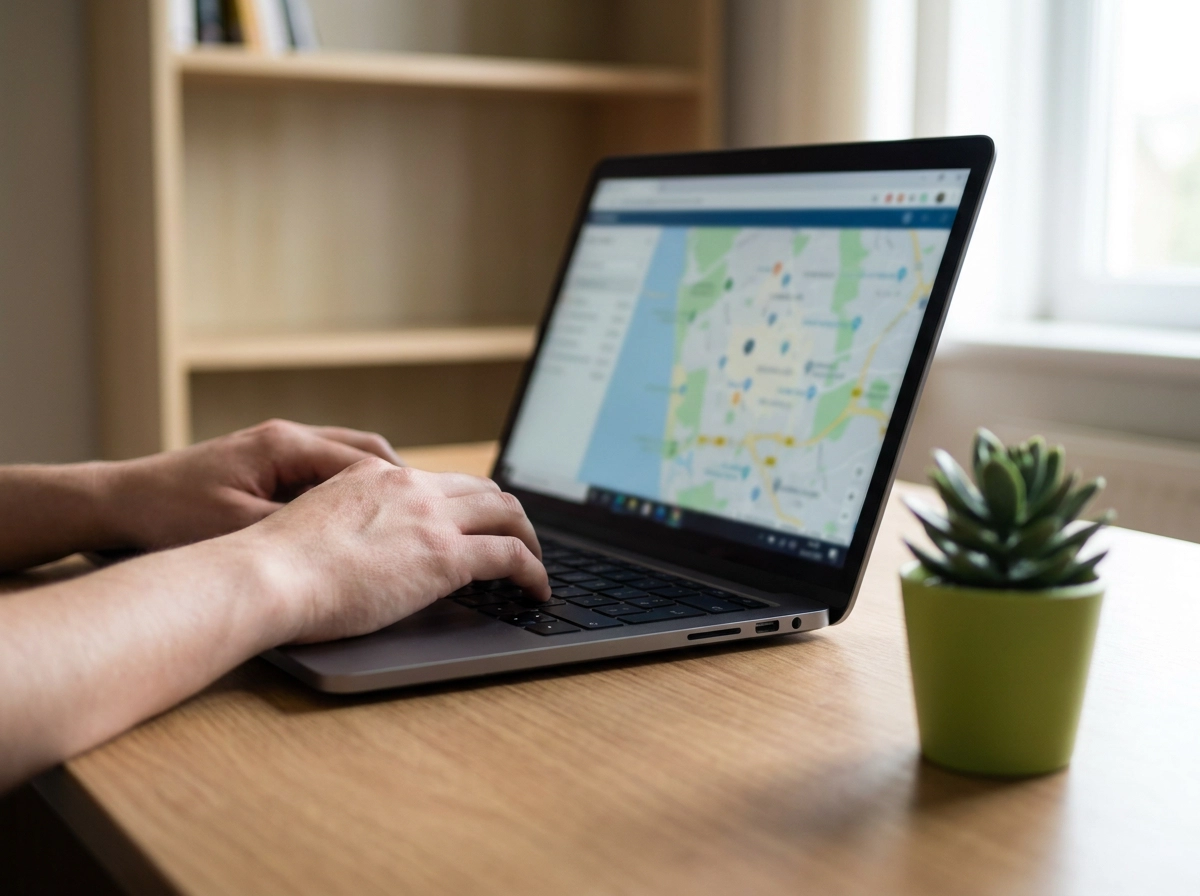
The question is no longer whether Irish SMEs should manage their local SEO, but whether they are meeting the baseline that visibility in 2026 demands.
Actively managing your Google Business Profile, building consistent review velocity, implementing LocalBusiness structured data, and maintaining citation accuracy across directories is not advanced SEO. It is the entry requirement. Businesses failing to do these things are not falling behind on extras; they are failing to meet the minimum standard for appearing in location-based searches at all.
Irish SMEs that treat local SEO as a revenue function rather than a technical checklist will give it the attention and budget it warrants. The return is measurable: more calls, more direction requests, more qualified foot traffic from people ready to buy.
The immediate actions are straightforward. Claim and fully complete your Google Business Profile. Audit your on-site local schema to confirm LocalBusiness markup is correctly implemented. Launch a simple review generation process, starting with post-service prompts to existing customers. Then check your citation consistency across Irish and national directories, because conflicting NAP data quietly undermines everything else.
If you are ready to grow your online business with 2Cubed, the starting point is a local SEO strategy built for sustained Local Pack visibility. If your business is not appearing where your customers are searching, that conversation is worth having.
Conclusion
Google Maps visibility is no longer a marketing nice-to-have; it is a direct driver of revenue for Irish businesses. The evidence is clear: the Local Pack captures the majority of clicks, conversion intent is highest among location-based searchers, and the gap between optimised and neglected listings is widening every month.
Four priorities separate businesses that appear from those that do not: a fully optimised Google Business Profile, consistent review velocity, accurate citations, and properly implemented local schema. Each one is achievable. None of them require enterprise budgets.
The minimum standard has changed, and the cost of ignoring that shift shows up in missed calls, lost foot traffic, and competitors taking ground that should be yours.
Start with the website audit. Fix the fundamentals. Treat local SEO as the revenue function it already is, and the results will follow. View the SEO Services we offer or contact us today to see how 2Cubed can manage your website SEO.