For many businesses, the website feels “finished.” It looks modern, the branding is consistent, and everything appears to function as expected.
But despite that, enquiries are low, bounce rates are high, and the site doesn’t seem to generate meaningful results.
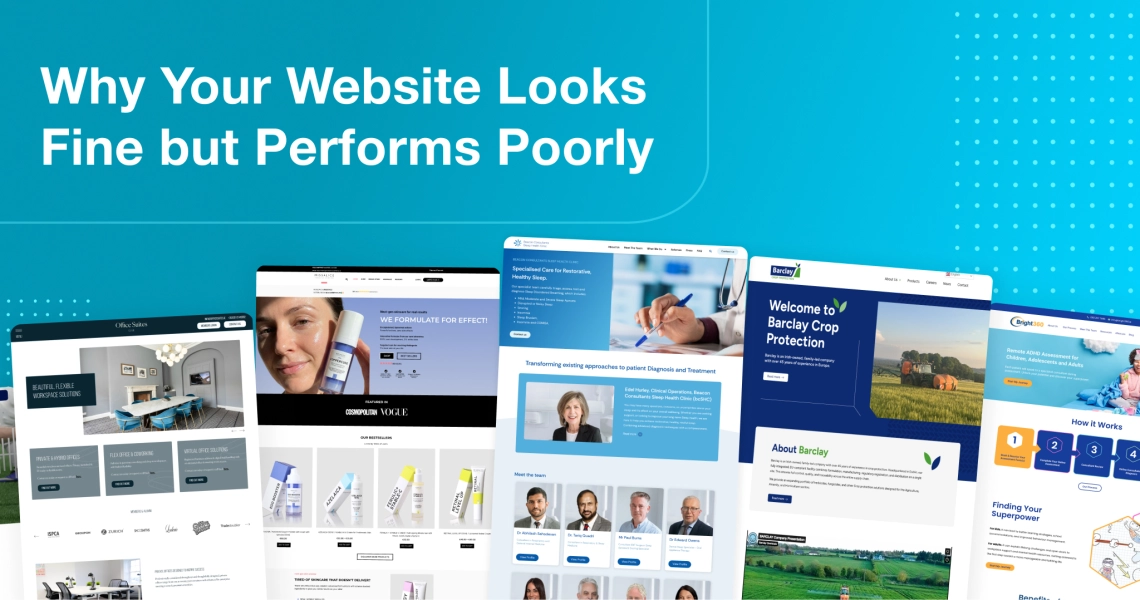
In 2026, this is a common problem: websites that look good but don’t perform well.
The issue is rarely visual design. It’s structure, clarity, and how the website actually guides users toward action.
Looks Don’t Equal Performance
A visually polished website can still fail if it doesn’t answer user intent quickly and clearly.
Users don’t evaluate websites the way businesses do. They don’t notice spacing, typography, or subtle design details first. They ask one question:
- “Can this solve my problem?”
If the answer isn’t immediate, they leave regardless of how good the site looks.
Common issues hidden behind “good design” include:
- Beautiful layouts with unclear messaging
- Strong branding but weak calls-to-action
- Stylish pages that don’t explain services properly
- Homepage designs that prioritise aesthetics over clarity
A website can look impressive and still fail to convert.
Design Without Strategy Creates Confusion
Many websites are built as design projects, not conversion systems.
This often results in:
- Pages that look polished but don’t have a clear purpose
- Navigation that feels modern but isn’t intuitive
- Content that is well-written but not structured for scanning
- Journeys that don’t guide users toward enquiry points
When strategy is missing, users are left to figure things out themselves. Most won’t.
Performance Issues Are Often Structural, Not Visual
When a website underperforms, businesses often assume they need a redesign. But in many cases, the visual design isn’t the problem.
The real issues are usually structural:
- Weak page hierarchy
- Unclear service positioning
- Poor internal linking between key pages
- Missing or underused conversion points
These are invisible problems but they directly impact results.
Why “Good Looking” Websites Still Lose Leads
A website can pass every visual check and still fail where it matters most: conversion.
This usually happens when:
- Users don’t understand the offer quickly enough
- There is no clear path from landing page to enquiry
- Trust signals (case studies, proof, testimonials) are buried or missing
- Pages don’t reinforce a single clear message
The result is simple: users browse, but they don’t act.
The Gap Between Design and Business Goals
The biggest issue isn’t design quality it’s alignment.
A website might be designed to look impressive, but not to:
- Generate enquiries
- Support SEO or AEO visibility
- Guide users through a structured journey
- Convert interest into action
When design and business goals aren’t aligned, the website becomes a brochure instead of a growth tool.
Turning a “Good Looking” Website Into a High-Performing One
Improving performance doesn’t always mean starting over. Often, it means refining what already exists:
- Clarifying messaging on key landing pages
- Reworking page structure to match user intent
- Strengthening calls-to-action across the site
- Improving service explanation and hierarchy
- Adding proof elements where decisions are made
Small structural changes often deliver bigger results than visual redesigns.
Final Thoughts
A successful website needs to do more than look the part it needs to support your business goals and guide users towards action. At 2Cubed, our web design services combine thoughtful design, clear structure and conversion-focused user journeys to create websites that deliver measurable results. Explore our Web Design services to learn how we can create a website that works harder for your business.