Most Irish retailers choosing an eCommerce website design partner make the same costly mistake: they treat it like a price comparison exercise. They collect three quotes, pick the most affordable option, and end up with a website that looks reasonable but fails to convert, struggles to integrate with existing systems, and leaves them exposed on compliance.
The Irish eCommerce web design market is more fragmented than most retailers realise. With 484 agencies currently listed in the national directory and significant variation in technical maturity, the difference between a capable partner and an expensive disappointment often comes down to questions you never thought to ask.
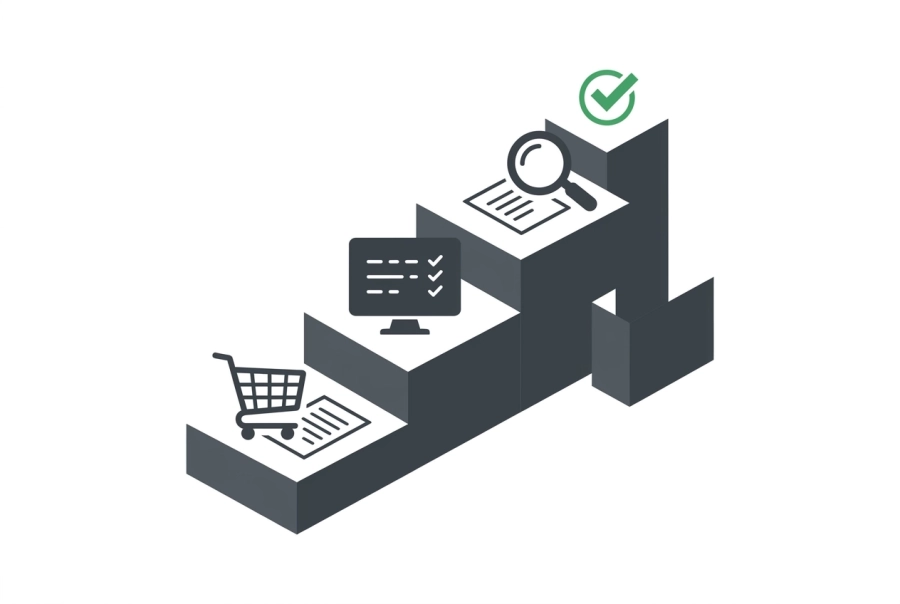
This guide reframes the entire selection process as a capability audit. You will learn how to define your requirements before briefing anyone, how to test platform expertise and integration depth, what compliance and security capability actually looks like in practice, and how to scrutinise post-launch support before you sign anything. You will also get a practical checklist and a clear list of red flags to watch for throughout the process.
Choosing the right agency is not about finding the best-looking portfolio. It is about buying outcomes.
Why This Decision Is Harder Than It Looks
Picking an eCommerce web design agency in Ireland looks straightforward until you start. The market is vast, pricing signals are unreliable, and most agencies present a polished front that reveals very little about actual technical capability.
The scale of the problem is measurable. As of September 2026, Clutch lists 484 Irish web design companies, yet only 15 hold Leader status and 15 are ranked as Contenders. That means roughly 97% of the market operates without any third-party verification of capability or client satisfaction. For a retailer briefing agencies, that is a significant information gap with real commercial consequences.
Price variance compounds the problem. Day rates and project quotes vary enormously across the market, and lower figures rarely reflect equivalent value. They typically reflect shallower platform expertise, limited integration experience, or post-launch support that amounts to little more than an email address. A cheap build is not a bargain if it requires a rebuild within 18 months.
The real cost of a poor eCommerce website is not the original invoice. It is the conversion rate that never reached its potential, the inventory sync that silently failed, the security incident that exposed customer data, and the cost of starting over with a new agency when the first build cannot scale. Those costs dwarf the initial saving.
Most retailers walk into this process carrying a design brief: preferred colours, a competitor site they admire, a vague target launch date. That framing selects for aesthetically capable agencies rather than technically capable ones. The brief should function as a capability audit, covering platform depth, integration experience, compliance readiness, and scalability from the outset.
Treating agency selection as a commercial decision rather than a creative one changes which questions get asked. It also changes which agencies remain credible once those questions are answered honestly. Before exploring those questions, it helps to understand how the Irish agency landscape is actually structured.
Understand the Irish eCommerce Agency Landscape First
That fragmented market context matters precisely because it shapes what kind of agency you are likely to encounter at each stage of your shortlist.
Geography influences capability in ways that are easy to overlook. Dublin agencies operate inside a dense tech ecosystem, which tends to produce stronger integrations experience and access to specialist talent. Cork agencies frequently reflect the region’s cybersecurity strengths, making them better positioned for security-conscious eCommerce builds. Galway’s medtech cluster has shaped local agency thinking around UX rigour and compliance architecture. Limerick’s advanced manufacturing corridor means agencies there often have deeper systems integration experience than their regional scale might suggest. If you are evaluating why a Dublin web design agency might suit your requirements, regional context is one legitimate factor alongside portfolio and platform depth.
Platform specialisation has become a primary differentiator. Agencies across Ireland build on Shopify, WooCommerce on WordPress, Drupal, and Webflow, but listing all four on a services page is not the same as deep eCommerce expertise across all four. The gap between familiarity and proven capability on a specific platform is where retailers most often discover they have chosen the wrong partner.
Multi-region agencies tend to have broader vertical exposure than those anchored to a single city cluster, simply because their client base spans more industries and operating contexts.
Tier classification matters for due diligence calibration. Of 484 listed agencies in the Irish market, only 15 are ranked as Leaders and 15 as Contenders. The majority carry no third-party verification of capability at all. Knowing where a shortlisted agency sits in that structure tells you how much independent validation you need to do before signing anything.
Pricing does not resolve this ambiguity. A mid-range quote from an unverified agency and a higher quote from a recognised Leader carry fundamentally different risk profiles, and treating them as comparable is where retailers make costly mistakes.
Step 1: Define Your eCommerce Requirements Before Briefing Anyone
Before you approach a single agency, you need to know exactly what you are asking them to build.
- Map your integrations first. List every system your store must connect to: payment gateways such as Stripe, Realex, or PayPal; your inventory management or ERP; fulfilment platforms; and analytics tools. Each carries a different build complexity and cost implication. An agency cannot price or architect your project accurately without this list, and vague briefs produce vague proposals that fall apart mid-build.
- Brief on future scale, not current state. Document your current SKU count, your realistic 24-month growth projection, and your peak traffic events, whether that is Black Friday, a January sale, or a seasonal product launch. Infrastructure decisions made for today’s traffic can fail under tomorrow’s load. Agencies need this context to recommend the right hosting architecture and platform tier from the outset.
- Identify your compliance obligations before platform selection. Under GDPR Article 32, data security measures must be appropriate to the risk your processing activities present. Cookie consent architecture, data retention policies, and any sector-specific requirements (food, pharmacy, financial services) all affect which platform is suitable and what the build will cost. Retrofitting compliance after launch is significantly more expensive than designing for it upfront.
- Understand your architecture options at a working level. You do not need to be a developer, but you should know the difference between a hosted SaaS platform, a self-hosted CMS, and a headless build. That working knowledge lets you judge whether an agency is recommending the right fit for your requirements, or the stack they find easiest to deliver.
- Scope post-launch expectations in writing before any contract is signed. Define your expected maintenance cadence, security update frequency, content support needs, and escalation contacts now. Our eCommerce website design process treats post-launch support as a defined deliverable, not an afterthought. That distinction matters more than most retailers realise until something goes wrong.
Step 2: Audit Platform Expertise, Not Just Platform Familiarity
Once your requirements are documented, the next test is whether your shortlisted agencies can actually build on the platform those requirements point to.
Listing Shopify, WooCommerce, and Webflow on a services page costs nothing. Demonstrated depth on any one of them takes years. Ask every agency to show you live eCommerce sites built on your chosen platform and provide references you can contact directly. A confident agency will do this without hesitation.
- For Shopify builds, the critical question is whether the agency understands platform tiers, not just the platform itself. Checkout UI extensions for payment and shipping steps are available only on Shopify Plus; an agency that cannot articulate this limitation has likely not worked at that tier. Equally important is their approach to the Shopify ecosystem: agencies that stack third-party apps to solve every requirement introduce compounding monthly costs and dependency risk that grows with your store. Ask specifically how they handle functionality that sits at the edge of Shopify’s native capabilities.
- For WooCommerce and WordPress builds, the failure points are rarely design-related. They are database optimisation under load, hosting architecture that cannot scale during peak traffic, and a plugin management approach that leaves security patches unapplied for months. These are precisely where low-cost builds collapse at scale. Ask how the agency structures hosting decisions and who is responsible for patching after launch.
Regardless of platform, ask directly whether the agency has migrated a live eCommerce store between platforms. Migration work requires handling complex data mapping, managing downtime risk, and maintaining SEO continuity. Agencies with migration experience have solved problems that new-build-only agencies have never encountered.
Official partner status for Shopify builds or WooExpert designation provides a baseline of independently verified competency that self-declared expertise does not. It is not a guarantee of quality, but it is a meaningful filter in a market where anyone can claim familiarity.
Finally, treat an unsolicited platform recommendation as a red flag. The right platform emerges from your integration requirements, your scale targets, and your compliance obligations; not from an agency’s preferred tech stack.
Step 3: Test Integration Depth Before You Commit
Once platform fit is confirmed, the next failure point is integration, and it is one of the most under-evaluated dimensions of eCommerce website development in Ireland. Most retailers only discover the gaps after launch: inventory figures drift out of sync, payment failures go unlogged, and fulfilment platforms stop receiving order data. By then, the agency has been paid and the damage is already with your customers.
- Require a written technical approach before any contract is signed. Present your full integration requirements at the briefing stage and ask for a specific written response. How will your ERP communicate with the storefront? What is the fallback behaviour when an API call fails? Who owns the monitoring once the site goes live? Vague answers at briefing stage predict vague accountability post-launch.
- Establish whether integrations are built in-house or subcontracted. This is a direct question worth asking plainly. Subcontracted integration work introduces an accountability gap: when something breaks, the agency must engage a third party before your issue is even diagnosed. That adds days to every resolution cycle, at exactly the moment your store is losing orders.
- Ask for documented examples of live integrations the agency has built and actively maintains. Payment gateway connections, fulfilment platform APIs, stock management systems, and CRM data flows are all standard requirements for Irish retailers, but not all agencies can deliver them reliably. Request specifics, not a general claim of capability.
- Scalability must be part of this conversation. An integration that performs at 500 orders per month may fail silently at 5,000. Ask whether load testing is part of the agency’s standard delivery process or an optional extra. Agencies offering structured Design, Development & Maintenance as a defined service are better placed to support integrations as your volumes grow.
Finally, probe the monitoring setup. If an API fails at 2am on a Tuesday, how does the agency find out? If the honest answer is “when you tell us,” that is not a monitoring setup, it is reactive firefighting dressed up as support.
Step 4: Evaluate Compliance and Security Capability
Integration gaps are costly. Compliance failures can be existential. Once you have tested an agency’s integration depth, apply the same rigour to how they handle regulatory and security obligations.
GDPR is a baseline, not a bolt-on. Every eCommerce website operating in Ireland processes personal data, making GDPR compliance mandatory from day one. Ask each agency directly: is cookie consent management, a privacy architecture review, and a data processing agreement included as standard deliverables, or are they billed separately? Agencies that treat these as optional extras are signalling that compliance is not part of their build standard.
PCI-DSS applies even with a hosted payment gateway. Using Stripe or a similar hosted provider reduces your compliance scope but does not eliminate it. The broader checkout flow, how card data is referenced, and how order data is stored all fall within PCI-DSS considerations. Ask agencies to confirm their approach to PCI-DSS scoping in writing; vague answers indicate they have not thought it through.
Accessibility is a growing legal obligation. WCAG 2.1 AA compliance is becoming an enforceable expectation for Irish eCommerce sites under EU accessibility legislation. Agencies that treat it as an afterthought will create compliance exposure as enforcement matures. Ask where accessibility sits in their standard build process.
Define security responsibilities contractually before signing. Establish in writing who is accountable for core platform updates, plugin or app patching, SSL certificate renewal, and vulnerability management after launch. This is not a detail to resolve post-go-live.
Backup and disaster recovery are frequently omitted from cheaper builds. Confirm the agency specifies backup frequency, offsite storage, and a tested restoration process as part of the eCommerce website build scope, not as an optional maintenance upgrade.
Finally, ask whether the agency has experience with data breach response or eCommerce security audits. Under GDPR Article 33, a breach must be reported to the Data Protection Commission within 72 hours. A partner handling your customer data should be able to support that process, not learn about it alongside you.
Step 5: Scrutinise Post-Launch Support, Not Just the Build Promise
Compliance and security obligations don’t end at launch, and neither does your agency’s responsibility. A well-built eCommerce store will degrade in performance, security, and conversion if ongoing support is reactive or structurally under-resourced. This is the dimension where capable agencies and commodity providers diverge most sharply.
- Require a written SLA before signing any proposal. The document should specify guaranteed response times for critical issues, and it should define what qualifies as critical. A checkout failure or site downtime warrants a different response window than a content edit request. If an agency cannot produce a written SLA, their post-launch support is informal by definition.
- Audit the maintenance package in detail. Ask whether it covers security updates, platform version upgrades, performance monitoring, and content support, or whether it is a nominal monthly retainer that resolves to little in practice. A one-second delay in page load time can reduce conversion rates by 7%, according to Akamai research, so performance monitoring is not optional maintenance; it is revenue protection.
- Ask how many active post-launch clients the agency currently supports, and how their support team is structured. A small agency carrying a large active client base may lack the capacity to respond promptly when your checkout goes down on a Friday evening. Headcount and team structure are reasonable questions; any reluctance to answer them is informative.
- Client retention rate is a reliable proxy for post-launch satisfaction. An agency confident in their ongoing service should be willing to share indicative retention figures or connect you with long-term clients who can speak honestly about the relationship after the build excitement has faded.
Agencies that offer structured website maintenance and technical support as a named service line, rather than handling requests informally on an ad hoc basis, provide clearer accountability from the outset. If you want to understand what support beyond your website launch should look like in practice, that distinction between a structured service and an informal arrangement is the right place to start.
Step 6: Demand Outcome Evidence, Not Just Portfolio Aesthetics
Once you have verified post-launch support commitments, shift your scrutiny to what an agency can actually prove about the sites they have built.
A polished portfolio is not performance evidence. Ask every agency on your shortlist for quantified outcomes from completed eCommerce projects: conversion rate improvements, page speed gains, measurable reductions in cart abandonment, or revenue growth attributed to the build. If they cannot supply figures, they either did not track them or the results do not flatter the work.
When reviewing case studies, distinguish between launch announcements and before-and-after data. An agency that publishes post-launch metrics is demonstrably more outcome-focused than one that showcases design screenshots and client logos. A 100-millisecond delay in page load reduces conversion rates by approximately 7%; an agency that tracks Core Web Vitals on live sites they have built understands this. One that does not monitor them post-launch is not managing the commercial asset they sold you, regardless of how well it looked at go-live.
Vertical experience carries more weight than project volume. An agency with five successful eCommerce builds in your sector, whether that is homewares, B2B trade, or food and beverage, understands buyer behaviour, catalogue structures, and sector-specific integration requirements in a way a generalist with fifty varied brochure-to-transactional projects may not. Ask specifically how many of their completed eCommerce projects serve your industry, and ask to speak to those clients directly.
For external validation, third-party platforms carry more credibility than testimonials the agency has curated on their own website. With 484 Irish web design agencies listed and only 30 formally classified as Leaders or Contenders, verified reviews matter. Check review recency, not just overall star ratings; sustained quality looks different from a strong historical reputation that has plateaued.
Finally, request references from Irish eCommerce clients specifically, not general web design clients. Transactional builds carry integration, compliance, and performance complexity that a brochure site does not. Agencies with a proven track record with our Web Design and dedicated eCommerce capability will welcome that distinction; those without it will find reasons to redirect the conversation.
The Capability Audit Checklist: What to Ask Every Agency
Once you have reviewed outcome evidence, consolidate your evaluation into six direct questions. Put these to every agency on your shortlist and compare how specifically they answer.
Platform expertise: “Can you show me live eCommerce sites built on my chosen platform, with references I can contact directly?” Vague portfolio links are insufficient. You need a working URL and a client willing to take your call.
Integration experience: “Walk me through how you connected a specific system on a previous project. Who built it, who owns monitoring, and what happens when an API call fails?” An agency with genuine integration depth will answer this in technical detail without hesitation. Generalities indicate limited hands-on experience.
Compliance standards: “How do you handle GDPR consent architecture, PCI-DSS scoping, and WCAG 2.1 AA accessibility in your standard eCommerce build?” Compliance should be a default deliverable, not a billable extra. The EDPB has tightened requirements around consent flows for online shopping specifically, so expect a concrete answer covering explicit opt-in mechanisms and documented withdrawal paths.
Security and maintenance: “What does your post-launch maintenance package cover, what are your SLA response times for critical issues, and who specifically handles security patching on my account?” Named accountabilities matter here. “We take care of it” is not an SLA.
Outcome tracking: “What performance metrics do you measure and report after launch, and can you share conversion or revenue data from comparable Irish eCommerce projects?” An agency that does not track post-launch performance cannot demonstrate that what they built actually works.
Scalability: “How have you handled traffic spikes and SKU growth for existing clients, and what infrastructure decisions do you recommend for a store at my scale target within 24 months?” This question distinguishes agencies that plan for growth from those that build only for current state.
Score each agency on the quality and specificity of their responses, not on the confidence with which they are delivered.
Red Flags to Watch for During Agency Selection
Knowing the right questions to ask is only useful if you can recognise a poor answer when you hear one. These six patterns are consistent signals that an agency is not the right fit for a serious eCommerce build.
The proposal skips discovery. If a proposal leads with pricing tiers and design concepts before the agency has asked about your integration stack or compliance obligations, they are selling a pre-built template dressed as a custom solution. A capable agency cannot scope accurately without understanding your requirements first.
SLA language is vague or verbal. Phrases like “we’ll be in touch quickly” or “we take care of everything after launch” are not service levels; they are deflections. Structured post-launch support has defined response times, escalation paths, and documented scope. If an agency cannot produce a written SLA, assume support will be reactive and inconsistent.
Compliance answers are generic. Any agency working on Irish eCommerce websites should be able to name their specific approach to GDPR consent architecture and PCI-DSS scoping. “We follow best practices” is not a compliance position. Vague answers here indicate the agency is taking on regulatory responsibility it is not equipped to manage, and the exposure lands on your business.
The portfolio contains only visuals. Design screenshots tell you nothing about conversion performance, load times, or client satisfaction. If a portfolio has no outcome metrics, no third-party references, and no performance data, the agency is measuring its own work by how it looks rather than how it performs.
Platform recommendation comes before requirements. An agency that names their preferred platform in the first conversation, before completing any discovery, is working from capability constraints rather than your actual needs. Platform fit should follow requirements, not precede them.
The quote is unusually low. A low number is a scope question, not a saving. Before proceeding, request a written itemised breakdown confirming what is included: hosting, SSL, integrations, testing, accessibility audit, and post-launch support hours. If any of these are absent, the true cost will appear later, after launch, when leverage is gone.
Buy Outcomes, Not Websites
Spotting red flags narrows your shortlist. Applying a structured capability audit closes it.
The five dimensions covered in this guide, platform expertise, integration depth, compliance standards, post-launch support, and outcome evidence, are not a wishlist. They are the minimum due diligence for any eCommerce investment with real commercial stakes. An agency that cannot answer clearly across all five is not a capable partner; it is a risk you are paying to take on.
That due diligence is not optional in the Irish market. With 484 agencies listed and only 30 formally recognised as Leaders or Contenders, the majority of providers operate without third-party verification of capability. Price signals nothing reliable in a market this fragmented. Structured evaluation does.
The right agency for your eCommerce website in Ireland is not the cheapest quote or the most visually arresting portfolio. It is the agency whose verified capability matches the actual complexity of what you are building, the integrations, the compliance obligations, the traffic targets, and the support requirements that exist long after launch day.
2Cubed, based in Wexford and Dublin, delivers eCommerce web development, SEO, and ongoing website maintenance as named, structured service lines. For Irish SMEs that need a capable long-term partner rather than a transactional build vendor, that combination matters. It means the agency accountable for building your store is also accountable for its performance, security, and growth after it goes live.
Before you sign any proposal, use the checklist in this post to audit every agency on your shortlist against the five capability dimensions. If you would like to discuss your specific eCommerce requirements directly, contact 2Cubed to start that conversation.
Conclusion

Choosing an eCommerce agency in Ireland is a commercial decision, not a creative one. The right partner brings verified platform expertise, proven integration capability, watertight compliance knowledge, and a structured commitment to post-launch performance. In a market with hundreds of providers and limited third-party verification, structured evaluation is the only reliable filter.
Price and portfolio aesthetics will mislead you. Capability evidence will not.
Use the checklist in this post before signing any proposal. Audit every agency against the five capability dimensions. Ask the hard questions about support, compliance, and outcomes. Demand specifics, not generalities.
With dedicated service lines across eCommerce development, SEO, and ongoing website maintenance, they are built to be the long-term partner your business actually needs.
If you are ready to build an eCommerce store that performs commercially long after launch day, contact 2Cubed.