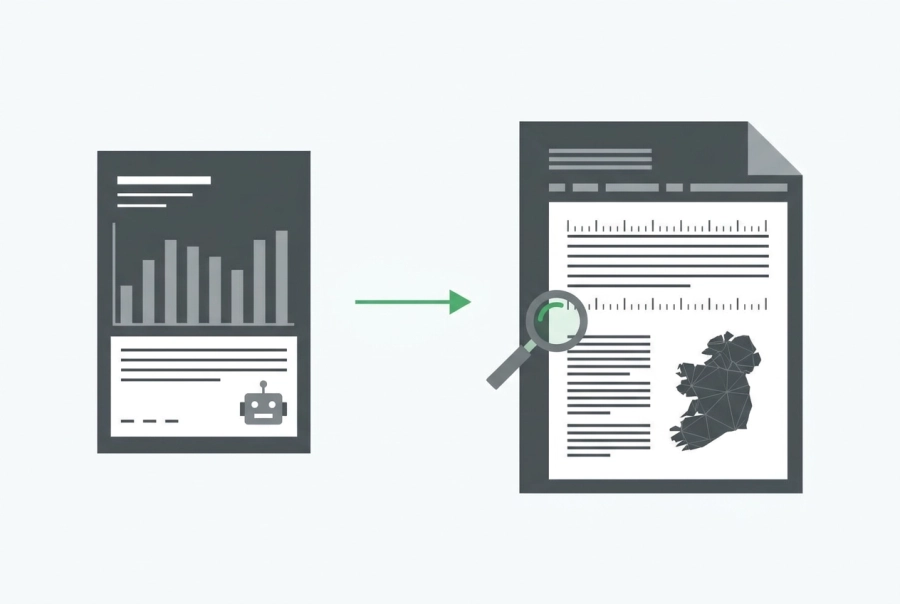
Every Irish business owner with a website has received the same email: “We ran a free SEO audit on your site and found critical errors.” It lands in your inbox looking urgent, professional, and alarming. But here is the truth most agencies will not tell you: that PDF is rarely a diagnosis. It is a sales document dressed up as expertise.
If you are trying to make sense of SEO services Ireland has to offer, knowing the difference between a genuine audit and a marketing pitch is one of the most valuable things you can learn. A real SEO audit is a structured, sequential process that examines how search engines crawl your site, which pages they actually index, how fast your pages load for real users, what your content covers versus what your competitors cover, and where your backlink profile stands.
This post walks through each of those layers in plain language. By the end, you will know exactly what a proper audit contains, what the red flags look like in a weak report, and how to approach commissioning one for your Irish business with confidence.
The Free Audit Problem Facing Irish SMEs
If you run an Irish business website, you have almost certainly received one. An email arrives promising a “free SEO audit,” you submit your URL, and within minutes a PDF lands in your inbox declaring your site has critical issues that need urgent attention. It feels like insight. It is, in most cases, a lead generation tool generated by an automated scanning tool and repackaged as bespoke analysis.
The core problem is a mislabelling one. A keyword ranking report tells you where your pages currently sit in Google results. It says nothing about why those positions have stalled, or what structural barriers are preventing improvement. That distinction matters enormously for any SME trying to make an informed decision about where to invest.
Free automated reports typically surface a domain authority score and a short list of keyword positions. What they routinely hide are crawl errors, broken redirect chains, and indexation gaps, which are the actual causes of ranking problems in the majority of cases. Fixing content on pages Google cannot properly access is wasted effort and wasted budget.
There is a second failure that is just as common: diagnosis without prioritisation. An audit that lists twenty technical issues without ranking them by severity or business impact does not give you a plan. It gives you a checklist that creates work without directing it.
Understanding what a proper audit genuinely covers is the first practical filter for identifying which SEO agency in Ireland is worth a conversation, and which is handing you a formatted PDF dressed up as strategy.
What a Real SEO Audit Actually Covers
So what does a credible audit actually look like beneath the surface?
A genuine audit follows a fixed diagnostic sequence: crawlability, indexation, technical penalties, Core Web Vitals, on-page content signals, and competitive gaps. That order is not arbitrary. Each layer depends on the one before it; surfacing content gaps on a page Google cannot crawl produces findings that are meaningless in practice.
Agencies aligned with recognised industry standards follow this crawlability-first methodology. Those delivering keyword-only reports skip the structural work entirely, and that gap is a direct indicator of how much their process can be trusted.
A properly scoped technical SEO audit spans 40 to 47 discrete checks across technical infrastructure, on-page signals, backlink profile, and site performance. A two-page PDF covers none of that ground credibly, regardless of what it claims on the cover.
The reason sequencing matters so much: nine times out of ten, stalled rankings trace back to technical infrastructure problems rather than content gaps. The fixes that move the needle most are precisely those that free automated tools never surface.
One further dimension separates thorough audits in 2026 from those built on older frameworks. A complete audit now assesses AI search visibility, examining whether key pages are being cited by tools such as ChatGPT, Gemini, or Perplexity, alongside traditional Google organic rankings. Visibility in generative search is already influencing how Irish buyers discover businesses, and an audit that ignores it is already incomplete.
Crawlability and Indexation: The Foundation Everything Else Rests On
Crawlability is where a proper audit begins. If Google’s bots cannot reach a page, every euro spent refining that page’s content achieves nothing. The page simply does not exist in search results, regardless of how well it is written.
robots.txt is the first file an auditor examines. This configuration file tells search engines which parts of a site to crawl. A single misplaced line can accidentally block an entire product or service section from Google’s index. This error is particularly common on Irish SME websites after a redesign or platform migration, where robots.txt settings from a staging environment carry into the live site unnoticed.
XML sitemaps come next. A clean, current sitemap submitted through Google Search Console signals to Google which pages matter. A real audit checks whether the sitemap contains noindexed or redirected pages. Including those wastes crawl budget, the limited time Google allocates to crawling your site on each visit.
Canonical tags confirm that duplicate content is handled correctly, ensuring Google indexes the preferred version of each page rather than splitting authority across near-identical URLs.
Internal linking is a prominent consideration. Key pages should be reachable within three clicks from the homepage. Orphaned pages with no internal links rarely rank, because crawlers have no reliable path to find them. This connects directly to the broader question of what a well-structured Irish business website should include in 2026, where site architecture and navigation are foundational, not cosmetic.
Core Web Vitals in Plain Language: Why Your Site Speed Is a Ranking Factor
Once crawlability and indexation are confirmed, a proper audit examines how your site performs for real users. This is where Core Web Vitals come in.
Core Web Vitals are Google’s three officially confirmed ranking factors, not advisory suggestions. Each measures a distinct dimension of user experience:
- Largest Contentful Paint (LCP): how quickly the main content loads. Threshold: under 2.5 seconds.
- Interaction to Next Paint (INP): how fast the page responds to a click or tap. Threshold: under 200 milliseconds.
- Cumulative Layout Shift (CLS): whether page elements jump around as the page loads. Threshold: under 0.1.
For an Irish SME, failing any single metric is enough to suppress rankings. A poor result increases bounce rate directly, meaning potential customers leave before seeing your product, service, or contact details.
The critical distinction a proper audit makes is between flagging a failure and diagnosing its cause. Unoptimised images, render-blocking scripts, and slow server response times are three of the most common culprits, each requiring a different fix. An audit that reports a “Poor” LCP score without identifying the source leaves you no closer to resolving it.
Understanding why website speed is more critical than ever puts this in commercial context. SEO optimisation efforts in Ireland that overlook Core Web Vitals are forfeiting ranking gains that are measurable and recoverable. Page experience is now inseparable from technical SEO.
On-Page Signals, Content Depth, and Search Intent
Once technical performance is in order, a real audit turns to what the page is actually saying and whether it is saying the right thing to the right audience.
Most free reports confirm that a title tag exists. A proper on-page audit asks a harder question: does this page genuinely satisfy the search intent behind the query it is targeting? Google’s ranking systems are designed to match pages to what users actually need, not merely pages that contain the right words. A page targeting “accountant Dublin” that leads with company history rather than services and contact information is misaligned with intent, regardless of whether its metadata is technically present.
Content depth and topical authority are assessed together. A site that covers a subject thoroughly and connects related pages through logical internal linking signals far more expertise than a collection of thin, isolated pages. How your website structure impacts SEO in this respect is measurable and auditable.
Structured data receives separate scrutiny. Schema markup for business information, services, reviews, and FAQs is verified for accuracy, because correct markup enables rich results in search, which directly improves click-through rates.
Heading hierarchy, internal anchor text, and keyword placement are reviewed to confirm the page communicates its subject clearly to both users and crawlers, not simply to tick boxes.
A credible SEO expert in Ireland treats this as a layer that sits on top of solid technical foundations. Content analysis cannot compensate for crawl errors or poor page experience; it complements them once those issues are resolved.
Backlink Profile and Competitive Gap Analysis
With on-page signals and content structure confirmed, a proper audit turns to backlinks, but sequence matters. Backlink analysis belongs late in the process because a weak technical foundation limits how much authority any incoming link can actually transfer. Auditing links before fixing crawl errors and Core Web Vitals is like checking the paint on a car with a failing engine.
A backlink audit examines the quality, relevance, and diversity of sites linking to your domain. The key questions are whether those links come from credible, relevant sources; whether toxic or spammy links are suppressing rankings; and how your link profile compares to competitors in your sector. That last point connects to competitive gap analysis, which maps the keywords and topics your direct Irish competitors rank for that your site does not. This is more actionable than abstract keyword volume data because it reflects what the market has already validated.
Trust signals are assessed alongside link quality. These include the age and authority of linking domains, the presence of local Irish citations in directories such as Golden Pages, and whether your NAP (name, address, phone) data is consistent across every listing. Inconsistent NAP data is a frequently overlooked issue for Irish SMEs and genuinely affects local ranking signals. For a fuller picture of how local visibility connects to revenue, the Google Maps ranking decisions Irish businesses face post covers the wider implications.
Any SEO services provider in Ireland who leads a proposal with backlinks before confirming technical health is either misordering the process or prioritising a higher-margin upsell over your actual results.
Red Flags to Watch for in Any SEO Audit Report
Knowing what a legitimate audit should contain makes it easier to spot one that falls short. Five warning signs are worth committing to memory before you accept any report.
It arrived within minutes. A thorough audit covering 40 to 47 discrete checks cannot be completed by a human analyst in under an hour. Instant delivery confirms an automated tool with no structured diagnostic process behind it.
Rankings are the only output. A document showing keyword positions and nothing else is a rankings report, not an audit. It describes where pages sit; it offers no diagnosis of why, or what is blocking improvement.
There is no prioritisation of fixes. A credible report sequences issues by severity and estimated ranking impact. A flat list with no triage is a data dump that creates busywork rather than a clear plan of action.
Crawlability and indexation are not mentioned. These are the first two steps in any legitimate audit framework. Their absence confirms automatic generation without a qualified analyst. As covered earlier, fixing content on pages Google cannot reach accomplishes nothing.
There is no connection to business outcomes. The purpose of any seo optimization ireland engagement is to generate more traffic, enquiries, and revenue. An audit that never references those outcomes is built for a sales conversation, not your business. The same due diligence applies when choosing any digital agency partner in Ireland, where capability matters far more than the initial pitch.
How Often Should an Irish Business Run an SEO Audit
Knowing a report is flawed is only half the problem. The other half is knowing how often a legitimate audit should happen.
Quarterly is the baseline. Algorithm updates, CMS plugin changes, and new content additions can each introduce crawl errors, broken redirects, or performance regressions between reviews. Running a technical audit every three months keeps issues from compounding silently.
Certain events require an immediate, unscheduled audit regardless of when the last one was:
- Website migration or redesign. These are the most common trigger for sudden ranking drops on Irish SME sites. Redirect chains break, pages get deindexed, and internal linking structures collapse during rebuilds. An audit immediately after launch is damage control, not optional.
- A significant Google algorithm update. If organic traffic in Google Search Console drops without an obvious explanation, a focused audit of the affected signals is warranted even if the quarterly review is weeks away.
Between full audits, ongoing monitoring through Google Search Console and a crawl tool functions as an early warning system. This monitoring only becomes meaningful once a proper audit has established a reliable baseline; without that baseline, anomalies are invisible. For practical guidance on review frequency, this overview of website maintenance frequency covers the broader picture.
Agencies that handle both web design and SEO, such as 2Cubed, can identify and resolve SEO-critical issues during a build rather than retroactively. For an SME working within a realistic budget, that integration is more efficient than commissioning a remedial audit after a redesign has already caused damage.
What to Do Before You Commission an SEO Audit
Knowing when to run an audit is only half the equation. Choosing the right agency to conduct it is the other.
Before you commission any audit, ask the agency to walk you through their process step by step. A credible SEO agency in Ireland should be able to describe their sequence from crawlability through to competitive gap analysis without hesitation or vague generalities. If they cannot, that gap in process tells you something important.
Request a sample audit or a redacted real-client report before agreeing to anything. What you are looking for is evidence that the deliverable covers technical infrastructure, Core Web Vitals, on-page signals, and backlinks. A document that shows only keyword rankings is a rankings report, not a diagnostic audit, regardless of how it is labelled.
Confirm that the output includes prioritised recommendations tied to business impact. A raw list of issues generated by an automated tool creates work without direction. You need to know which problems matter most and why, not a spreadsheet of flags with no triage applied.
Check whether the agency has in-house development capability to implement the fixes they identify. An audit that leaves you holding a list of technical tasks with no one to action them transfers the burden entirely onto you.
A genuine audit is an investment in understanding precisely what is holding your website back. At 2Cubed, our SEO service is built around that diagnostic rigour from the outset, so you receive a clear picture of the problem and a team equipped to resolve it.
Conclusion
An SEO audit is only as valuable as the rigour behind it. For Irish businesses serious about organic growth, the key takeaways are straightforward: technical foundations and crawlability must come first; site speed and Core Web Vitals directly influence rankings; on-page content and backlinks determine how competitive you can realistically become; and any audit worth commissioning should deliver prioritised recommendations, not just a list of automated flags.

Understanding these pillars puts you in a stronger position to evaluate who you hire and what you receive.
If your current website is underperforming in search, the answers are almost always inside a proper diagnostic. Do not settle for a free tool report dressed up as strategy.
Get in touch with the 2Cubed team today and find out exactly what is holding your site back, and what it will take to move it forward.